
Well, after the probably unjustifiable disappointment that the English student endured last week, I admit it was wonderful to get back to that most beautiful of languages (yes, even more beautiful than English): numbers. After what felt like months of revision, the new semester begin in earnest, centering on geometry, with a little statistics thrown in, because we wouldn't want to make things too much fun (pretty sure statisticians were put on earth to make astrologists look good). We kicked things off with circles, and circle theorems. We got reacquainted with different terminology (circumference, diameter, radius, nothing new) and a few that perhaps some of us weren't familiar with. The chord for example.
A chord, generally speaking, is a line segment joining any two points in a circle, or indeed on any kind of curve. The diameter for example is actually a specific type of chord, although the term chord is usually used to refer to an unequal splitting of the circle into two segments, one major and one minor (no points for guessing which is which). The other slightly less well known term is the tangent. A tangent, informally speaking, is a line that touches the curve of the circle, or any shape with a curve, at a single point. To elucidate further, consider a ball resting on a flat plane. Only a very small part of the plane actually makes contact with a very small part of the ball. In this way, the plane can be said to be tangential to the ball (of course, this example is in three dimensions, but the principle holds just as well in two dimensions).
After that, we moved on to the actual theorems. Incidentally, a theorem in mathematics is simply a mathematical statement that has been proven to be true (based on certain axioms, which we'll not get in to just now). Another piece of jargon to remember is the term "inscribed angle". An inscribed angle simply means the the angle created when two chords in a circle share the same end point, creating an angle, the vertex of which lies on the arc of the circumference. All the angles in the example below for instance can be said to be inscribed angles.

Theorem 1: Subtended Angles in the same segment are equal to each other
So, let's take a look at the above illustration. The line AB is the chord divides our circle into a major segment and a minor segment as we discussed earlier. The angles ADB and ACB are what are known as subtended angles. A subtended angle simple means that the line running from A and the line running from B both meet at the same place on the arc of a circumference, and it refers to the angle created at that point. Therefore, if angle ADB is 45 degrees, that means that line AB subtends 45 degrees from point D. The first theorem means that angle ADB is equal to the angle ACB. So if we assume that ADB is 45 degrees, it mathematically follows that ACB must also be 45 degrees. Note that this theorem only applies to angles confined within the same segment of the circle, as shown below.

As you can clearly see, ADB does not equal ACB when the angles are in different segments on the circle. Something to bear in mind.
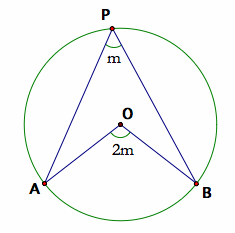
Theorem 2: An inscribed angle is half of the central angle
So, as we said earlier, an inscribed angle is the angle created when two chords share the same end point on the arc of the circumference, in this case, AP and BP both share the same endpoint, therefore P is an inscribed angle. The central angle is created when two radii sharing separate, distinct end points on an arc meet at the center, creating an angle that subtends the aforementioned arc. With me so far? In the case of the above diagram, the central angle is AOB, AO and BO being the radii that create the angle and O being the point the subtends the arc created by A and B. This theorem simply states that an inscribed angle is half of the central angle. In other words, if AOB = 120 degrees, APB will always equal 60 degrees. As with theorem 1, this only holds true if both angles occupy the same segment (the segments in this case being split by the chord created by A and B.

Theorem 3 (Thales' theorem): The diameter of a circle always subtends a right angle to any point on the circle
The final circle theorem we will deal with is called Thales' theorem, and it's by far the simplest of the three. It simply states that if A, B and C are points on a circle, and AC is the diameter, then the angle subtended by B will always be a right angle, regardless of the where on the circle it is. Simple, easy to remember, but useful all the same.
Anyway, that's enough about circles, but we're not done with the theorems just yet, and this next one is possibly the most famous of all
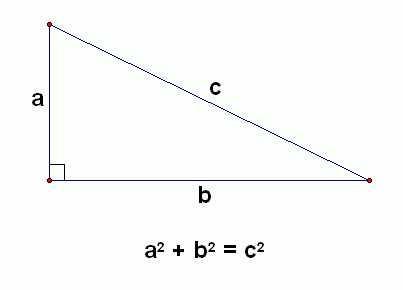
Pythagoras' Theorem
So, the Pythagorean theorem doesn't need much explanation, simply because everyone who's ever stepped foot in a GCSE maths classroom knows what it is, but let's take a look at it anyway. In the above triangle, the angle created by sides a and b is a right angle. The side opposite the right angle in a right angle triangle is called the hypotenuse, c in the above illustration. Pythagoras' theorem simply states that the square of the length of the hypotenuse is equal to the sum of the squares of the other two sides. This is shown in the above illustration. So, if a is 5cm, and b is 12 cm, we can use those values to calculate the length of c. I'm going to use ^2 to represent a number being squared, due to the limitations of my keyboard. So, a^2 is 25cm^2 and b^2 is 144cm^2. Adding these figures together we get 169cm^2. So, with that information, all we need to do to find the length of side c is find the square root of 169, which is 13. Therefore, side c is 13cm long.
I decided to skip over the frequency diagrams that we covered simply because they're not that interesting or difficult and they only appear on the may exams, but we might cover them a little nearer the time. Until then, the English student will be here on Thursday, I've been the Maths student, saying that such is the beauty of maths, something as simple as a circle can become interesting... or maybe that's just me.


No comments:
Post a Comment