So, David Silverman is at it again.
I happened to catch a glimpse of a... "debate", on Fox News the other day, and after a long eye bath while blasting one of theoreticalbullshit's videos on Youtube to clear it out of my system (check him out if you haven't, smart guy), I analysed it a little further. David Silverman, for those who don't know, is the president of American Atheists, an organisation that campaigns for the rights of atheists in America and that challenges Christianity when it gets special treatment in public, as it almost always does.
Now, I'm not a big fan of David Silverman. Like Richard Dawkins, his heart is in the right place and he should be lauded for his intent, but his tactics often do more harm than good (his anti-religious "you know it's a myth" billboard springs immediately to mind) but, as he himself said on a recent interview in The Guardian, he fights the battles that are not popular to fight, but need to be fought regardless. There is nothing more difficult than doing something you know you're going to be publicly crucified for (pun not intended) and I respect him for that. Now, let's take a look at what he's picking a fight over this time
So there's this iron cross at what has become known as ground zero, the sight of 9/11 that has become a memorial for all who lost their lives on that tragic day. Silverman is arguing that not only is this a religious symbol on public land, which he argues violates the US constitution, but that it is discriminatory to all the victims of 9/11 who weren't Christians. Now, let me make something quite clear. The cross in this instance doesn't really bother me. It's not something I would be campaigning so heavily about BUT that doesn't mean I don't agree with Silverman's points. On the first point, there is no grey area, he is absolutely right when he says the US constitution expressly forbids religious iconography on public ground. The establishment cause of the first amendment of the US constitution states "congress shall make no law respecting an establishment of religion". Well, what the constitution wants, the constitution gets, it's the same deal with the so called "war on Christmas" that Bill O' Reilly likes to bang on about every December because he, like many other Americans, insist that their religion gets special treatment, constitution says no. So much for 'murica being a "Christian nation".
As for the second point about discrimination, I personally don't feel discriminated against, but then again I wasn't an atheist/muslim/hindu/buddhist etc. who lost someone on 9/11. If there is to be a memorial erected, why shouldn't it be all inclusive? Why can't it be religiously neutral, in fact why should religion be brought in to it at all considering we're talking about a terrorist attack perpetrated by religious fundamentalist extremists? Because it's alright, so long as Christianity gets special treatment. I'm aware that there will be many Christians who agree with David Silverman, I know not all of Christianity can be tarnished with the same Ken Ham/Ray Comfort brush and I wouldn't dream of doing so, but to progressive Christians who may read this, I implore you: talk to your people.
12 March, 2014


11 February, 2014
The Maths Student: Standard Form
Well, after a week off, largely because what we did last week wasn't really meaty enough to warrant a full blog, we're back with a bang, and the first thing we're going to talk about is standard form.
Standard form (sometimes called scientific notation) is, broadly speaking, a way of writing numbers. See, this is the kind of analysis that makes me the hard-hitting investigative blogger that I am. More specifically speaking, standard form is a way of writing numbers that can't be conveniently represented by normal means. Even more specifically, the type of standard form we will be looking at, called normalized standard form, demands that the coefficient being used in standard form is at least 1, but not greater than 10. It's very commonly used in science, for example the age of the universe.
A number written using scientific notation looks like this

where the coefficient (represented by a) can be any number that is at least one but less than ten, and the exponent "b" is any integer.
So, if we look at the age of the universe for example, which is approximately 13.798 billion years old, or 13,798,000,000, we could write that number using normalized standard form, and it would look like this:
1.3798 x 10^10 (Times 10 to the 10th power)
In simple terms, the exponent, 9 in this case, is the number of places we are moving the decimal point by. If it's 9, we move the point 9 places to the right. Standard form can also be used to represent very small numbers. If we wanted to write 0.0000001, we could write that using standard form as 1 x 10^-7. A - sign in this case means we move the point to the left, not the right. Standard form is a simple, beautifully elegant way of writing large numbers, and it's very much worth remembering.
This is a new format I'm trying out, a bite-size approach, rather than one blog for the whole class, so expect another one later in the week, until then, I've been the maths student, signing off.
28 January, 2014
The Maths Student: Circle Theorems and Pythagoras

Well, after the probably unjustifiable disappointment that the English student endured last week, I admit it was wonderful to get back to that most beautiful of languages (yes, even more beautiful than English): numbers. After what felt like months of revision, the new semester begin in earnest, centering on geometry, with a little statistics thrown in, because we wouldn't want to make things too much fun (pretty sure statisticians were put on earth to make astrologists look good). We kicked things off with circles, and circle theorems. We got reacquainted with different terminology (circumference, diameter, radius, nothing new) and a few that perhaps some of us weren't familiar with. The chord for example.
A chord, generally speaking, is a line segment joining any two points in a circle, or indeed on any kind of curve. The diameter for example is actually a specific type of chord, although the term chord is usually used to refer to an unequal splitting of the circle into two segments, one major and one minor (no points for guessing which is which). The other slightly less well known term is the tangent. A tangent, informally speaking, is a line that touches the curve of the circle, or any shape with a curve, at a single point. To elucidate further, consider a ball resting on a flat plane. Only a very small part of the plane actually makes contact with a very small part of the ball. In this way, the plane can be said to be tangential to the ball (of course, this example is in three dimensions, but the principle holds just as well in two dimensions).
After that, we moved on to the actual theorems. Incidentally, a theorem in mathematics is simply a mathematical statement that has been proven to be true (based on certain axioms, which we'll not get in to just now). Another piece of jargon to remember is the term "inscribed angle". An inscribed angle simply means the the angle created when two chords in a circle share the same end point, creating an angle, the vertex of which lies on the arc of the circumference. All the angles in the example below for instance can be said to be inscribed angles.

Theorem 1: Subtended Angles in the same segment are equal to each other
So, let's take a look at the above illustration. The line AB is the chord divides our circle into a major segment and a minor segment as we discussed earlier. The angles ADB and ACB are what are known as subtended angles. A subtended angle simple means that the line running from A and the line running from B both meet at the same place on the arc of a circumference, and it refers to the angle created at that point. Therefore, if angle ADB is 45 degrees, that means that line AB subtends 45 degrees from point D. The first theorem means that angle ADB is equal to the angle ACB. So if we assume that ADB is 45 degrees, it mathematically follows that ACB must also be 45 degrees. Note that this theorem only applies to angles confined within the same segment of the circle, as shown below.

As you can clearly see, ADB does not equal ACB when the angles are in different segments on the circle. Something to bear in mind.
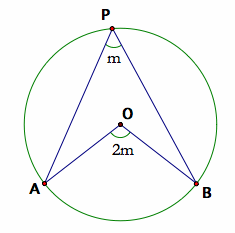
Theorem 2: An inscribed angle is half of the central angle
So, as we said earlier, an inscribed angle is the angle created when two chords share the same end point on the arc of the circumference, in this case, AP and BP both share the same endpoint, therefore P is an inscribed angle. The central angle is created when two radii sharing separate, distinct end points on an arc meet at the center, creating an angle that subtends the aforementioned arc. With me so far? In the case of the above diagram, the central angle is AOB, AO and BO being the radii that create the angle and O being the point the subtends the arc created by A and B. This theorem simply states that an inscribed angle is half of the central angle. In other words, if AOB = 120 degrees, APB will always equal 60 degrees. As with theorem 1, this only holds true if both angles occupy the same segment (the segments in this case being split by the chord created by A and B.
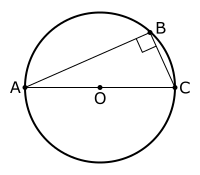
Theorem 3 (Thales' theorem): The diameter of a circle always subtends a right angle to any point on the circle
The final circle theorem we will deal with is called Thales' theorem, and it's by far the simplest of the three. It simply states that if A, B and C are points on a circle, and AC is the diameter, then the angle subtended by B will always be a right angle, regardless of the where on the circle it is. Simple, easy to remember, but useful all the same.
Anyway, that's enough about circles, but we're not done with the theorems just yet, and this next one is possibly the most famous of all
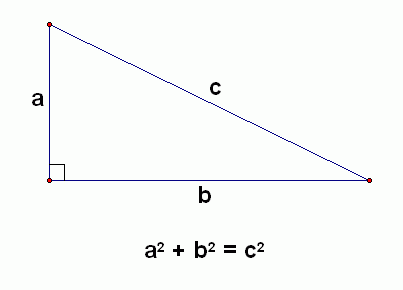
Pythagoras' Theorem
So, the Pythagorean theorem doesn't need much explanation, simply because everyone who's ever stepped foot in a GCSE maths classroom knows what it is, but let's take a look at it anyway. In the above triangle, the angle created by sides a and b is a right angle. The side opposite the right angle in a right angle triangle is called the hypotenuse, c in the above illustration. Pythagoras' theorem simply states that the square of the length of the hypotenuse is equal to the sum of the squares of the other two sides. This is shown in the above illustration. So, if a is 5cm, and b is 12 cm, we can use those values to calculate the length of c. I'm going to use ^2 to represent a number being squared, due to the limitations of my keyboard. So, a^2 is 25cm^2 and b^2 is 144cm^2. Adding these figures together we get 169cm^2. So, with that information, all we need to do to find the length of side c is find the square root of 169, which is 13. Therefore, side c is 13cm long.
I decided to skip over the frequency diagrams that we covered simply because they're not that interesting or difficult and they only appear on the may exams, but we might cover them a little nearer the time. Until then, the English student will be here on Thursday, I've been the Maths student, saying that such is the beauty of maths, something as simple as a circle can become interesting... or maybe that's just me.
23 January, 2014
The English Student: Derailed
So, the exams have come and gone, and so let the inevitable postmortem begin in earnest. While the maths student will be awaiting his results until Monday at the soonest, I got my English results on Wednesday night. I scored 79% overall. I haven't quite managed to shake off the totality of the disappointment that may or may not have been justified in the first place, but open a deeper dissection of the results, there is actually some cause for cautious optimism
For those who read my last blog, the structure of the English exam is already familiar but for those who didn't (I can only assume you were comatose or battling an alien invasion at the time) the layout was straightforward, there were 4 questions and without going into detail on what they were, questions 1 and 3 were quite rigid in their format, not allowing for a great deal of freedom or expression. 2 and 4 on the other hand did allow for that expression, with 4 being an essay on the question of "Does a longer life lead to a better life". I scored much more highly on 2 and 4, the essay in particular as it was a very nebulous kind of question that was open to a lot of personal interpretation and allowed one to infuse a lot more of their own opinions, personality and style of writing into their work. We face another barrage of exams in mid May, and we were informed on Wednesday night that these exams will be a lot more geared towards questions like 2 and 4, allowing more freedom. With that in mind, I will be looking to improve on my score come May.
In addition to getting our results back, we were also given a brief outline of what faces us this coming term. The brunt of the work will center around two poets, Wilfred Owen and Sean O' Casey, particularly the latter, as we will be asked to give a 10 minute presentation on an aspect of O' Casey's life or work in front of the class, which should be a lot of fun (sadly, my request to give my presentation on Einstein's theory of special relativity was turned down). Still, should be fun.
So, signing off with this admittedly rather threadbare blog, which is only the case because that was literally all we did in English this past week, the maths student will be here on Monday with inevitably better results than I have, and until then, I've been the English student, and I'm apparently not doing so good at it. Goodnight :)
09 January, 2014
The English Student: ...and the train kept a-rollin'
It's a funny thing, when I was at school (the first time, that is) English was actually my favourite subject. It was easy, poetry, writing, analysis, speaking, it all came so naturally. Fast forward 5 years and the tables could not be anymore turned without tunneling into higher-dimensional space. A fresh start coupled with a new found respect has seen mathematics rapidly and without contest ascend into the position of my favourite subject, while my love of English (only the subject, not the language) has withered over the course of the last 4 months. But, I am still an English student, so I feel compelled to find something to talk about on the subject.
So, on Monday night, the maths student, lucky bugger that he is, was enjoying calculations and demonstrations while deliberatin' and a-conjugatin' the emancipation proclamation (South Park reference, don't ask me why, I don't even watch the show) in preparation as our train keeps a-thunderin' inevitably on towards examination station on Monday. In that same spirit, last night our class was doing some last minute preparation for our English exam, also on Monday. The general format of the exam is essentially the following. Question 1 asks one to elucidate the meaning of certain phrases that are proliferated throughout the passage that we have been given to analyze. Nothing too difficult, although it did lead to something of a comedic moment when my friend Katrina and I translated "generally considered to die" to "widely believed to expire". Replacing words with their direct synonyms is probably not an unsound strategy, although I have no difficulty imagining an examiner having a particularly bad day would dock a few marks for it as their is an undercurrent of tongue-in-cheek to the answer. Safest practice if one is truly lost is to try and grasp the context the words are spoken in, target the words that you do know the meaning of and make an educated assessment on the balance of probability regarding the meaning of the rest of the words. Also this has already been stressed by our tutor Rodney, but I would hope it is fairly obvious not to use words already found in the phrase, other perhaps than conjunctives ("and, but, of, because, so, is" for example). So far so obvious.
Question 2 allows a little more freedom, in the case of the practice paper we were given, we were told to outline the three principle findings of the passage. Not too much time spent on any of them, just an outline and a little exposition, not too much, no need to go overboard, but it is a chance to demonstrate some flair, I would take it, partly to show off and partly for the sake of my own sanity that has been locked in mortal combat with the rigid structure of the subject as a whole.
Question 3 seems to be the one that trips a lot of people up. Essentially we are given a part of the passage and asked to boil the information down to it's most important, concise points and present it as a condensed summery, in the case of last night it was a 45 word summery for a passage lasting a few hundred words. This is where having an expansive vocabulary can be very useful, being able to condense a phrase down to a word or two is an invaluable asset for this, but it's not essentially that you be a walking thesaurus. Patience is key, take the time to plan the summery out, make a few rough drafts, be careful with how you use your language. One thing that was working really well for me was to strip the passage down to it's absolute bare essentials, to as few words as possible and then add bits of information in, rather than trying to take bits out after finding it was too long. If you can't, you can't, but if you can, then as I say, I found it helpful. One thing I can say for definite is that summaries are not as difficult as you think they are, just be careful with your language and don't be afraid to make rough drafts and tweak it until you're happy.
Question 4 is where the fun really begins, because this is the essay question. Usually, as was the case last night, the question posed is pretty vague and gives you a wide scope of material and arguments to work with. Last night it was "Does a longer life lead to happiness?". A question like that is money, there is so much you can do with it, there are so many arguments for and against, points to follow up on, analysis to be given, observations to be made, that you could very easily go on for a good 5-6 pages and only scratch the surface. As it is, 2 pages is probably as far as you should go, maybe 2 and a half, so it's important to be concise, but at the same time, for the sake of the quality of your work, and for the sake of your own sanity, try as far as possible to enjoy it, really try and get inside the mindset of the question, and of the sides arguing for and against it, and if you can't enjoy the question it's self, try, as with question 2, to at least enjoy the freedom that an essay format can give you to put your own stamp on your work, to imbue it with your own character and flair in a way you really couldn't when faced with the rigidity of questions 1 and 3.
So, we have passed our last stop, the exams are on the horizon and inching closer all the time. 0930 at examination station. Until then, I've been the English student, and wherefore (as in "wherefore art thou Romeo") does not mean where, it means why.
07 January, 2014
The Maths Student: 09:30 Train to Examination Station
Note to self: devote more time to coming up with wittier blog titles.
Anyway, for the indubitably vast, global audience that no doubt hangs on my every written syllable, I started an access course in September, and I thought it might be fun to pepper my blog with a more personal flavour, in addition to it's usual programming. Incidentally, Google chrome is informing me that I have spelled flavour wrong. Well you listen to me Google chrome, this is Britain! You hear me? Britain! You're not allowed to tell me something is spelled wrong just because it doesn't match up to your warped defilement of the majesty that is the English language. We only invented the bloody thing! Damn Americans.
Um... yeah, studying and stuff
For those who don't know, an access course is aimed primarily though by no means exclusively at people who, for whatever reason, don't have the necessary academic qualifications to get into university, or perhaps do, but not for the subject of their preference. In my case, I dropped out of school at the age of 17, four years ago next month as a matter of fact. After a few years in the wilderness, I decided I wanted to study theoretical physics, which has led me to this course, which will lead me to doing A-levels upon it's completion in 18 months, which will, all being well, lead to university in 2017. Now, background information, or to needlessly use some film terminology, establishing shot out of the way, let's actually look at the course it's self
Essentially, I and my classmates will be studying English and Maths at essentially GCSE level, in addition to the three major sciences at GCSE level in year one and AS level in year two, AS level for those who don't know being essentially the first year of a two year A-level course. In our first four months, we've looked at osmosis and basic anatomy in biology, the period table, salts, and fractional distillation in chemistry, and random and systematic errors, Hooke's law, and electrical resistance in physics. (Incidentally, as a heads up, I am very much in favour of Oxford commas) However, English and Maths are currently the more pertinent to discuss, as it is these two that we face exams for this coming Monday. Last night, Monday night that is, we had what was largely a review session of essentially everything we had covered in maths up to this point. Nothing too drastic in the grand scheme of things, the maths on the course being GCSE equivalent meaning that we faced nothing that had not been previously encountered. The few months we've spent doing maths has more or less been a refresher course, everything from shapes, angles, perimeter, area and volume to probability, averages, graphs, long multiplication and division, and multiplying and dividing by decimals and fractions. It's nothing new, but it has been 4 years since I was doing GCSE maths, and even longer for others. The information not being fresh coupled with the workload it's self being quite densely packed has resulted in the course, even doing it part time, being more intense than one might think for GCSE level, quite a few people in the class already having dropped out, our numbers having dwindled from 19 in September to 12 at present.
Tomorrow night brings English, the last stop on our journey before pulling into examination station on Monday. Ideally, I'll be doing a fairly broad review of English tomorrow night, and looking in more depth at each individual lesson in future, but with last night's and tomorrow night's classes largely being review sessions, it's not really feasible to cover everything we've done in four months in one blog. Still, promising beginnings, or so I feel. Until then, I've been the maths student, and I can confirm that two plus two does, in fact, equal four.
Subscribe to:
Posts (Atom)